
$49.00
USD
Research Use Only (RUO) • Not for Human or Veterinary Use • Not for Consumption.
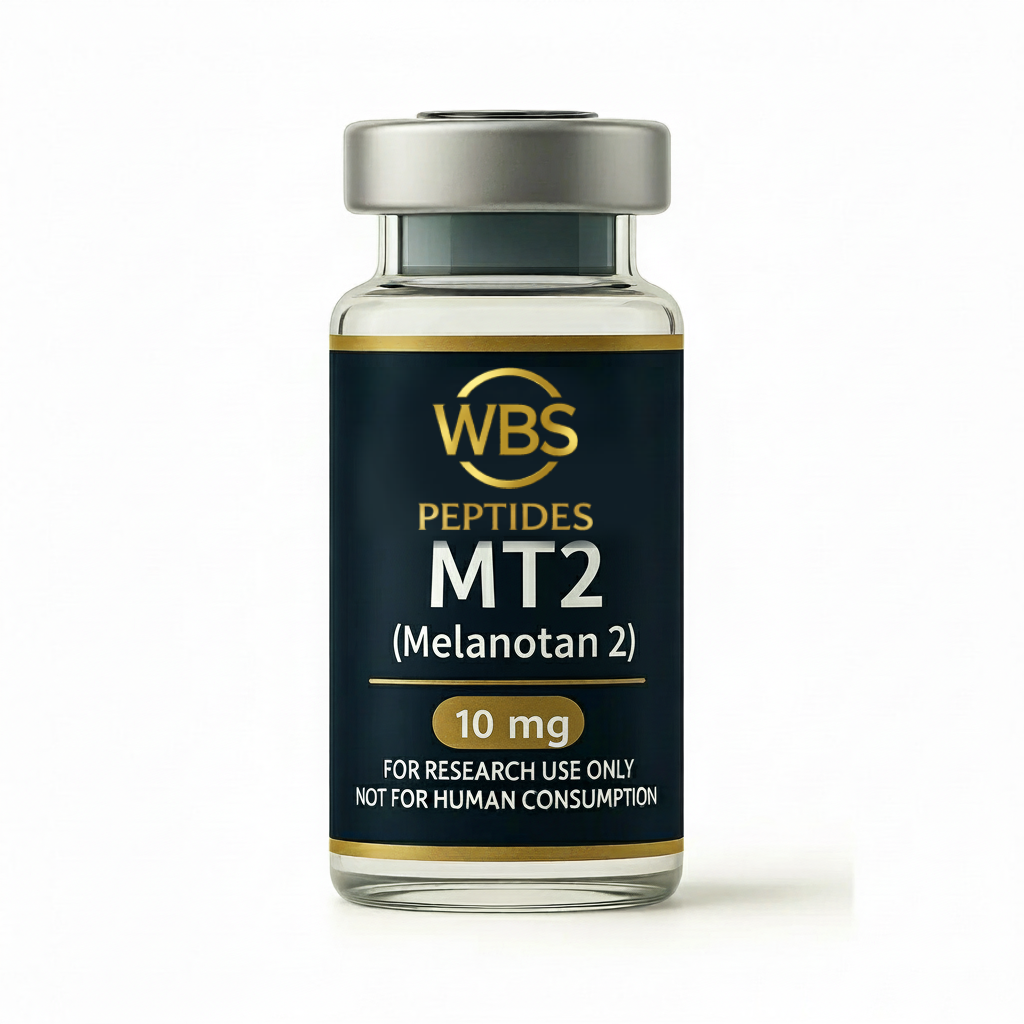
Melanotan 2 (also abbreviated MT-2 or MT-II) is a synthetic cyclic heptapeptide described as an analog of alpha-melanocyte-stimulating hormone (α‑MSH). In controlled research settings, the melanotan 2 peptide is used to explore melanocortin receptor signaling and pathway‑level readouts relevant to melanogenesis, CNS signaling, and metabolic research models. This page is provided for laboratory context only.
SEO note (natural terms used on-page): Researchers may also search for melanotan 2 peptide, MT2 peptide, MT-II peptide, alpha MSH analog peptide, and melanocortin receptor agonist. These phrases are integrated below in RUO-safe, non-clinical context.
| Product Name | Melanotan 2 (MT-II) |
|---|---|
| Sequence | Ac-Nle-Asp(1)-His-D-Phe-Arg-Trp-Lys(1)-NH2 |
| CAS Number | 121062-08-6 |
| Molecular Formula | C50H69N15O9 |
| Molar Mass | 1024.18 g/mol |
| Purity | ≥99.0% (HPLC verified) |
| Form | Lyophilized white powder |
| Verification | HPLC / MS tested (batch-based) |
| Documentation | CoA / SDS available upon request |
| Grade | Research Use Only (RUO) |
Melanotan 2 is frequently referenced as a non‑selective melanocortin receptor agonist, with activity reported across MC1R, MC3R, MC4R, and MC5R in experimental systems. Its cyclic structure is commonly described as supporting enhanced stability compared with linear α‑MSH analogs, which is useful for reproducible assay design and receptor‑signaling workflows.
If you’re searching where to buy melanotan 2, prioritize a supplier that labels MT‑2 strictly as Research Use Only and supports reproducibility with HPLC purity verification, MS identity confirmation, and batch traceability (CoA/SDS). Peptides Skin supplies melanotan 2 lyophilized powder for controlled research workflows and qualified laboratory buyers.
A common query is what is the difference between melanotan 1 and 2. In research literature, MT‑1 and MT‑2 are discussed as α‑MSH‑related peptides that can differ in sequence design, receptor activity profiles, and experimental behavior. Researchers typically select MT‑2 vs MT‑1 based on study goals, receptor subtype focus (e.g., MC1R/MC4R), and assay endpoints.
The melanotan 2 peptide is widely used to study melanogenesis in model systems, including MC1R‑linked signaling and downstream pathway markers associated with melanin production. These experiments may support broader investigations into photobiology, pigmentation biology, and cellular response pathways in non‑clinical models.
For how to store melanotan 2, laboratories typically keep lyophilized MT‑2 at −20°C, protected from light and moisture. Storage should follow your facility SOP and batch documentation. To minimize variability, avoid repeated temperature cycling and limit exposure to humidity.
Another frequent question is how long does melanotan 2 last in the fridge. Stability depends on solvent system, concentration, container, and contamination controls. For RUO workflows, prepared solutions are usually treated as short‑term and refrigerated per SOP, with aliquoting used to reduce repeated freeze–thaw cycles. Always follow the stability window defined by your protocol and documentation.
Searches for how to reconstitute melanotan 2 are common. In research workflows, reconstitution is performed using sterile technique and an appropriate laboratory‑grade aqueous solvent selected for the assay. Solvent choice, pH, and final concentration are protocol‑dependent; follow your lab SOP and do not use this product for any human or veterinary purpose.
Melanotan 2 is a synthetic cyclic heptapeptide described as an α‑MSH analog used in laboratory research to investigate melanocortin receptor signaling and related pathway readouts in controlled models.
When evaluating where to buy melanotan 2 for research, select an RUO‑labeled supplier that provides batch documentation (CoA/SDS) and analytical verification such as HPLC and MS.
Melanotan 1 vs melanotan 2 differences are typically discussed in terms of sequence design and receptor activity profiles. Selection depends on the model, receptor target, and endpoints defined by the study.
Lyophilized MT‑2 is commonly stored at −20°C. Prepared solutions are typically refrigerated short‑term per SOP; stability depends on solvent and protocol, so follow your lab documentation.
Reconstitution should be performed using sterile technique and an appropriate laboratory‑grade solvent selected for your assay. Do not interpret this as administration guidance.
WhatsApp us